Psychology Scams

A handful of times I’ve learned of acquaintances falling for psychological diagnostic scams. The most notable are a urine test telling neurotransmitter deficiency and a brain scan to diagnose a mood disorder (Amen Clinic).

I can understand wanting a definitive diagnosis. I know how frustrating it is to go from doctor to doctor with a new diagnosis each time.
When hearing of these two scams, my initial reaction was skepticism and interest. Why had I never heard of them before? Why had no one ever recommended them for me? Quick searches for more information revealed why I’d not heard of these tests.

Neurotransmitter levels in urine do not necessarily reflect the amount of the neurotransmitter in the brain.

We don’t know enough to use brain scans for diagnosis of most psychiatric problems. There are a lot of studies finding differences between the brains of healthy controls and people with a specific problem, but a lot more research needs to be done to use it diagnostically.

Of course there are things that can be diagnosed with brain scans, which makes the Amen Clinic’s service seem legitimate. We can spot brain tumors for one. I even have a friend who had his schizophrenia diagnosis confirmed with an MRI. It’s important to realize that he would have still been diagnosed with schizophrenia regardless of what the the MRI scan showed, it just provided additional evidence for the diagnosis. Also, schizophrenia is a disorder with a larger body of MRI research.

We are no where near being ready to look at a persons brain and tell them they are bipolar.

Unfortunately one of my friends doesn’t realize this and shelled out a lot of money (looks like $3,375.00. according to the website) for this procedure. This clinic also takes a general history. I’m betting that’s where the bipolar diagnosis came from, not the overpriced photos of her brain.

If someone has a lot of money they don’t mind wasting they should go into the two different locations and tell different fake symptoms and then leave with two different diagnoses.

I wonder if the people running these know the science is shoddy? Maybe one person at the top knows and the underlings follow blindly.

If I thought these tests worked I’d get them done in a heartbeat. I want concrete answers. I want to know what is wrong and exactly how to fix it. The guesswork is exasperating. It’s unfortunate that this desire gets taken advantage of.

The people I know who bought into these scams to do not know the tests are bogus. They were given diagnoses and a recommended drug. What do I do? Do I educate them? Or maybe the damage is done and I should leave them be?
They were told in fancy sounding terms what FDA approved drug to take. The treatment plans they were told were nothing dangerous. It’s possible they are getting placebo benefit from this. I’d hate to ruin it if it’s helping them.

But, what if the drug isn’t the right fit? Are they going to feel trapped into taking it when alternatives might be preferable? Or feel hopeless/un-fixable if it doesn’t work?

I also have concern about them advocating the test to others. They share in common this enthusiasm about the test, thinking they’ve uncovered this secret hidden away by the medical community. Should they be told, so others are not dragged into this?

I’ve decided to mind my own business, but I feel a level of guilt over it. As a not-very-close-friend I feel saying more would cross a line.
I wonder how a therapist would/should handle a patient who begins therapy armed with this false information. It’s going to be hard to form a therapeutic alliance by shooting it down at the start. But if the information doesn’t fit with the best treatment plan then something needs to be done.

What do you think? Have you heard of other similar scams?
Grades Obsession

I need to get out of this mindset where I think an A- is a bad grade.
I wasn’t like this before.
My first semester of college I got a mix of As and Bs and I felt quite good.
My second semester I got all As I was thrilled.
My third semester, again I got all As.
By my 4th semester I was thinking ‘wow It’d be neat if I kept this all As thing going, and again all As
Now it’s my 5th semester. It’s no longer just an neat thing, I feel I have to do it.

Right now my GPA is being pulled down by an A- (the Bs from that first semester transferred to my new school and don’t factor into GPA).
This pattern started because I was enjoying classes and putting a lot of time into them as a result. Now this pressure is destroying my ability to enjoy the learning.

I just want so badly to watch my GPA to creep up closer to a 4.0, undoing the damage of the A-. I want to discover if there’s a point where a 3.99999999 can be rounded up to a pretty 4.0. How many decimal places are needed?

I need to keep telling myself ‘You don’t have to go to an Ivy League school for grad school.’
I’m not even sure the particular Ivy league school I’m thinking of has the type of program I want.
I guess as long as I get into grad school it’s okay?
No. I need my little bit of elitism. As long as it’s not a state school (No. <3 you Emi. Do you even read this? We can go to state school together. Future Alumni of Generic State School ftw?)

I’ve had a series of academic disappointments this week. When school is your life that makes them bigger
-The student I tutor got a D+ on her test. Which makes me feel awful, since it’s my job to try to keep that from happening. We’re going over it tomorrow to see what happened. I feel really bad, especially because I though she had a good sense of the material.
-I didn’t get into a really interesting class I wanted to take.
-I got an A- on a paper. I realize that isn’t awful. I just can’t consider it good. I lost some points because I didn’t italicize the volume number in my APA citation. It’s worse when it’s something that preventable.
-I had two peer writing workshops that were useless. I’d been looking forward to them, because I’m excited about my paper and wanted feedback. I don’t feel like my classmates took it seriously. The only constructive criticism was spotting a few typos. Rip my paper to shreds please? I can handle it I promise. As long as it’s not a bad grade, I’ll find it helpful.

I hate that I’ve become one of ‘those people’. I wasn’t one of them in high school. They say if you graduate high school without doing drugs it’s unlikely you’ll start after. I guess the same doesn’t apply to being obsessed with grades.

Closets

I like closets.

My earliest closet memory is from elementary school. I had a walk in closet. The floor contained a village of “littlest pet shop” toys. I’d sneak in at night when I was supposed to be asleep and silently act out scenarios with these toys. When finished, I’d arrange the toys to match the way they looked on the box they’d come in. However a box displayed a toy was the correct way for it to be used. Deviating from this was acceptable as long as it was returned properly in the end.
I’d also sneak into this closet and read. Reading in the closet was far better than under the covers with a flashlight.

When my family moved my brother and I argued over who would get what room. We both wanted the room with two closets. In the end I won and got that room. I don’t think my brother minded much, as the room he got was larger. I used one closet for clothing and the other I filled with pillows and blankets. It became a cozy reading corner.

In high school my mom and I had frequent arguments. Asking her to “leave me alone” resulted in the opposite effect. During a fight I’d sneak away and hide in one of my closets. I could wait safely under piles of clothing until things cooled down.

Closet-like situations are also nice. When I began self-injuring I’d do it in the bathtub with the shower curtain pulled closed. We didn’t have working locks on the bathroom doors. Being walked in on was a concern. I realized I liked the small safe space of the bathtub with the curtain closed and began closing it even when not self injuring.

My sophomore year of high school I came out of the metaphorical closet and revealed that I am a lesbian. Departing this figurative closet didn’t end my enjoyment of the literal ones.

At my first hospitalization I sat curled up in a ball in the shower stall with the curtain drawn. It was a safe feeling place for an overwhelming situation.

At my third hospitalization there were lovely wardrobe-type closets. When overwhelmed I squeezed into one and shut the door. The woman on checks walked by and said my name. I didn’t have much energy and felt too apathetic to respond. Not long after the doors of the closet were aggressively pulled open and I was forced to stay in the main lounge. The lounge was a big open space, not at all like a closet. I later learned I’d given the woman on checks a scare and felt bad about it. That hadn’t been my intention. I tried to make light of the situation by saying I’d ‘learned it’s not a good idea to play hide and seek with the person on checks’. Later, after leaving, when reading my records, I found this comment had been quoted and listed as the reason why I’d been in the closet. They hadn’t understood the soothing effect the closet had on me. I wasn’t trying to be difficult.

The following day I climbed into the closet again. When the person on checks came by and said my name I responded, letting them know I was in the closet. I figured if they knew where I was there would be no problem and I’d be allowed to stay there. It didn’t work out as intended. Instead, I was surrounded by doctors and nurses and med students asking me questions. This was the opposite effect from what I wanted to achieve. I just wanted a quiet, safe space with minimal sensory input.

In my current residence I have a quite nice closet. On occasion I’ve curled up in it wrapped with a blanket. It smells like laundry detergent, because that’s where I store it. It’s a good size. Small enough to be cozy, but large enough to not feel squished.

And that’s how I feel about closets.

I scare people away

I had an appointment yesterday with a psychiatrist. The plan was to get someone to manage medication, no therapy. I selected a him randomly off my insurance’s website. Well not completely randomly. I took location into account and avoided names similar to names of past therapists. But it wasn’t credential based.

I allowed an hour for the 15 minute walk to his office. So I killed time in the area, anxiously watching the clock.

When I got to his office he handed me a Zoloft branded clipboard with a paper to fill out my insurance info. I took the clipboard to be a good sign. Normally I’d look down upon something like that, but in this case all I want are drugs so a drug clipboard seems appropriate.

His office was the biggest psychiatrist office I’ve ever seen. It’s bigger than where I live. It’s bigger than my parent’s master bedroom. The rent on an office that big in that neighborhood must be insane.

He was familiar with my old school. He kept talking about how selective it is. I don’t know if he was just saying that to try to make me feel more comfortable, but it worked. I was going to that school for a very small specialized program. People with no connection to it’s field often don’t understand that it’s hard to get into. Lower acceptance rate than Harvard. There’s usually an unspoken assumption that I transferred to go to a better school. In reality, selectivity wise my new school is a step down. But they really can’t be compared because they have such diffrent focuses. But it was nice to have my achievement of acceptance into that school recognized.

I went through my history. All seemed to be going well. That’s the problem with mental health professionals. I always think it’s going fine, because they hide what they’re thinking. A normal person would give me a reaction if I were making them uncomfortable. I’d have signals to go off of. In this case all seemed fine until I mentioned my self-injury. Then he started getting squirmy. And it went downhill from there. I should have not mentioned the self-injury. It’s not even that important. I was struggling to find the balance of telling enough to ensure he wouldn’t say I don’t need the drugs but hiding enough to not scare him. I fell into the scaring him territory.

If I keep making mental health professionals uncomfortable how can I even think of having friends I can be open with? These people don’t realize how much they reinforce my fears when they do something like this.

I know I make myself seen crazier because of how I talk about everything I’ve been through. I tell it all very emotionally detached. Blunted affect. At times my voice might waver a bit, but not for long.

He said I was placing too many conditions on him about what I wanted. I know what I need and want. I’m sorry if I’m not a person who does something just because a doctor says to. I have to look out for myself. I will not blindly follow a person no matter what educational qualifications they have. I can listen to advice, but at the end of the day I decide what I do.

He wasn’t feeling comfortable with me not being in therapy. He didn’t want to be responsible for me. The problem with first appointments is that all the bad stuff comes out first. It’s not until after that people are able to understand that while at my worst things are pretty bad, on a day to day basis I do quite well. I managed to make him feel a little more comfortable mentioning I was thinking of meeting with my past therapist over the summer.

He asked me if I’d left a past therapist because he’d stopped writing prescriptions. He hadn’t. I resented the question. I am very strongly opposed to recreational drug use. I don’t drink alcohol or coffee. I made a point of making this appointment before I ran out of drugs. So I could meet the psychiatrist during the first appointment and not need to ask for a refill. So it would be clear that drug abuse is not a problem.

The appointment ran 20 minutes late. I guess it was nice of him not to kick me out, but I don’t think that extra time helped much. I managed to make him feel a bit less scared of me, but he wanted his own conditions to work with me. He asked to talk to my old therapist (the one who I want to meet with this summer) so they could try to “work something out”. That’s so vague. What does work something out mean? I was digging my nails into my arm to keep from crying. I pulled out my phone to give him the past therapist’s number. Then he said not to make an decisions now. To think about it and call him next week. He also said I should call my old therapist first.

I’d been planning on putting off the phone call to my old therapist until mid-may. I figure I won’t know when I’m available for an appointment till then anyways so it didn’t make sense to call.
This new psychiatrist didn’t make any guarantees of working with me if I make this call. He could still make the decision to not work with me.

These people they don’t want to work with me because they’re worried about being liable. The irony is that then they leave me with nothing, putting me in a far worse situation. Ditching clients who seem too difficult should also make someone liable. There should be some responsibility to find a person comfortable with working with me. Sure most people will give a list of referrals. But generally I call those and none have openings or they don’t take insurance or they also are scared of me.

I’m not sure if I should put up with this new guy’s demands or find another one. Next time around I can hide more. It’s so hard to know what to hide. Everyone has diffrent thresholds.
I guess it’s nice that he didn’t flat out 100% reject me, but he nearly did and still might.

I just wanted to get away from this therapist drama and simply ensure I can continue getting prescriptions to maintain status quo. I guess that was too much to ask.

Knowing I don’t have any way in the near future to get a klonopin refill makes me feel the need to conserve it. Which means there will be situations when I should take one when I won’t. In general I take it less often that I probably should. When I don’t take it sometimes things escalate to worse levels, but it’s hard to tell the difference between a time when it will escalate and a time when it won’t. That’s scary. That I could be left without a thing that can help me because I’m more messed up that he expected me to be. Because I am more messed up and therefore need help more, I am less able to receive that help.

Quitting Therapy and the Potential Return

I quit therapy a week ago. It feels like longer. She didn’t handle the break up well. I wanted to leave it off in a way where I could feel comfortable coming back after a break but her resistance to my decision to leave sabotaged that. It was partially my fault for waiting until the end of the appointment to mention it, but it was also only my 4th appointment with her so leaving shouldn’t have been considered a big deal.
I feel burnt out about therapy. Theoretically, I would love to be in therapy. The reality doesn’t work the way I need. 10 therapists in a little over a year was just too much to handle. I’d repeat my history over and over, never quite catching them up to where prior therapists were. Therapists became somewhat disposable. I feel that taking a break might make the experience be more appreciated and valuable upon return. Hopefully that would make me better able to tolerate therapist’s imperfections in their ability to understand me.
I’m pretty depressed, but I don’t attribute it to the therapy situation, nor do I think therapy right now would help. At least I’ve got the extra time in my week freed up.

This break is going to last at least until summer.
This summer I am going to be living in the area where a prior therapist (S.M.) works. The decision I have to make is if I should call him to ask if I can meet with him during the summer. I probably will in the end call him, but I have worries about if this is a good idea.

Why I should call him:
1. He was the best therapist I’ve ever met with.
2. I plan on going to Grad school (If I get in where I want) in the city where he works. I would want to meet with him regularly then, so continuing this summer with him wouldn’t be strange since I plan to meet with him again in the future.
3.Even though it would be a short period of time it could help give me insight into the problems I’ve had with staying in therapy with the same therapist since I moved here.
4. It would be wonderful to meet with a therapist who already knows my background information. I just would have to fill him in on the past year and a half. Not the other 20 years of my life.

Why I should not call him:
1. I’m worried he’ll say no. Saying no because of a full work load is fine, but if he said no because he objected to only meeting for a few months rather than long term, I’d be crushed. I’d feel stupid for even asking.
2. I’m worried it would crush my idealization of him. He helped me realize I could major in psychology, that I didn’t have to love it but hate those who used it. Because he is a good person who uses psychology. What if i went back and decided I didn’t like him anymore? I don’t know if I could handle that.
3.I have trouble talking about my interest in psychology to therapists. I get worried about saying something wrong. I feel very intimidated. I’ll talk about computers or photography non-stop, but psychology; I’ll say nothing. Anyone else I’ll babble about Freud to for hours, but not a therapist. When I left him to transfer schools I didn’t tell him I was going to major in psychology even though this was my plan. I didn’t lie. I mislead. I talked about getting an MBA, which, it’s true, was at one time a consideration. After the psych undergrad, of course. This summer, I’ll be in the area for a psychology internship. All of my activities will revolve around psychology. If I can’t get over this problem or even mention that it is a problem, I’m not sure it makes sense to go.
4. I leaving would be hard.

Again, I’ll probably call him eventually. I just have a lot of worries.

I need to be heard

I need people to know what happened to me. I need people to know this happens. I want dialogue and awareness.

But I’m terrified of being blamed. There are people who will think this was my fault, not the fault of a flawed system.
These fears keep me silent.
There are so many things I can handle different options on, but not this. It is too personal. Defending them is an attack on me.

I don’t have the perfect way to tell my story. I have started so many drafts, saved on my computer, forgotten. I’m going to give bullet points a shot. I need to, if nothing else, get out the key points.

-A bit over 2 years ago I was feeling very depressed and suicidal.
-I felt terrified of myself and made an emergency appointment with my therapist so I could get help. He was a therapist in my college’s health center.
-He decided I should go to the hospital. I was not surprised by this and, though terrified, I agreed to go.
-When in the hospital he suggested I take the rest of the semester off. I said ‘no, school is too important to me’ and he said ‘well let’s see what the doctors at the hospital have to say’.
-I was feeling better and getting ready to be released. A meeting was held with my therapist, the hospital doctors and I. The hospital doctors said that when I was released it would be fine for me to return to school. I had decided I would drop a couple of classes, but that I wanted to return. My therapist disagreed with this.
-My therapist told me he was going to talk to the school and ask them to place me on an “involuntary medical leave”. He said he was going to talk to them whether or not I gave permission.
-After he left a hospital doctor told me “This is discrimination”
-After my therapist spoke with the school my parents spoke with a woman there to plead my case. They asked for her to please talk to the hospital doctors who had a different opinion. She refused, she was only interested in hearing what her employee (my therapist) had to say.
-The decision was made that I would be forced out of the school until they decided I could return.
-I moved out of the dorm and back in with my parents.
-One condition placed upon my return was to meet with a therapist and have that therapist speak with the school to discuss my return. On the surface this seems reasonable, but it isn’t. How can I have real therapy knowing anything I say might hurt my chances of returning to school? As a result, I had about 6 months of ‘fake therapy’.
-I stumbled upon a newspaper article telling about people who were in similar situations as myself. They had won legal cases against their school. I contacted the lawyers who had helped them.
-My case was taken pro-bono. They helped me file an OCR (office of civil rights) complaint. This was not a lawsuit. There were no financial damages. The complaint only asked for their policy to be changed, so what happened to me couldn’t happen to others.
-I won my OCR complaint and returned to school

Okay I’ll end the bullet points now.
It’s not such a happy ending though. When I returned to school things were not the same. I was a semester behind in a very small (40 people) program. It worked on a yearly cycle. The semester off put me a year behind and my absence had been noticed. People knew things. I don’t know how, but they did. No one knew the whole story, but there were rumors.
Based on these rumors I was harassed by my roommates who dug through my things and found my seroquel. From google searches they concluded that must mean I have schizophrenia ( I don’t) and that I was dangerous (I’m not) . They made demands to the RA wanting to be told why I had left the last year. In general they made my life miserable, trying to force me out. They succeeded. I not only left their room, I left the school.

In my new school now I’m paranoid. I extend a lot of energy protecting myself from the same situation repeating itself. I have trouble making friends because I worry if they get to know me too well they’ll realize how crazy I am and then the school will find out and somehow it will be used against me to kick me out. I know it’s illogical, but it shows how much this impacted me. I’m better informed now. Kicking me out would be hard if not impossible, but the thought terrifies me. It doesn’t help that I know this school did something similar to a classmate.
I have nightmares about this happening again. I see people who look like my old therapist and worry he’s gotten a job at my new school.
I love school and want to stay here.
It wasn’t damaging just from the lost semester. They kicked me when I was down. It damaged my ability to trust. It hurts me every day still.

If you know someone who is going through a similar situation send them here
http://www.bazelon.org/Where-We-Stand/Community-Integration/Campus-Mental-Health.aspx

Here’s an NPR story about this issue.

There’s also a facebook group I found today. It’s existence means so much to me.
I wish there were a support group I could go to with others who’ve experienced this. I feel like only people who’ve been through this can fully understand.

I want people to know they’re not alone and there are resources. When this happened to me I had no idea this was a widespread issue. It was a fluke I read that newspaper article.

Just to elaborate on some things:
-Justifying the schools actions by saying “I was a danger to myself” is not reasonable. If I had been a danger to myself then the hospital shouldn’t have been releasing me and it would have been an issue to take up with the hospital, not my school. School is for learning, not for judging my mental health.
-A major issue was my therapist’s duel roles. He wasn’t just my therapist, he was also an employee of the school. He was acting in the interests of the school, not for me.
-Another issue was my school refusing to talk to the hospital doctors. They couldn’t make an informed decision without hearing all sides.

Trichotillomania

Trichotillomania. I can’t spell the words “schedule“, “definitely” or “regularly” without the help of spellcheck, but I can spell “trichotillomania“. It’s a good thing, because wordpress’s spellcheck doesn’t recognize trichotillomania as a word.

Trichotillomania (compulsive hair pulling) is the one diagnosis I have that all mental health professionals I’ve met with are in agreement about. I, however, feel very out of place in internet communities for those who share my diagnosis. I don’t pull from my scalp, so my problem is more easily hidden. As a result, I don’t suffer from the social consequences that many people have to deal with.

My favorite hairs to pull are ingrown ones. They don’t belong. They’re already defective, they are guilt free pulling.

First I notice the irritation of the skin. Sometimes I can see the hair sometimes I can’t. When the area is more inflamed I poke it with a pin to release the fluid. Digging with tweezers, pins and fingernails I search for the hidden hair. Sometimes blood obstructs my work. I have to allow a day of rest before resuming.

I question the existence of the hair. Maybe I already pulled this one out and forgot? Maybe the skin was irritated from something other than a hair? Was that a shadow or a hair?

After some healing, I recommence my hair retrieval mission. When finally I free the hair from my , then mutilated, skin, I feel immense satisfaction. The greater the length of the hair the greater the satisfaction. The visual is very important to me. I study it wondering how long it had been hiding in my body. Sometimes dead skin is firmly attached to the strand. I slide it off carefully, examine both hair and skin individually and dispose of them.

I replay the scene over and over in my head, eagerly awaiting my next opportunity to repeat it.

Nose hairs are my second most favorite type of hair to pull. They are also the most uncomfortable to discuss. There’s such social stigma about putting fingers up a nose, pulling out a hair there is even worse. I can comfortably tell therapists I pull pubic hair, but often omit the nose hair.

Using tweezers makes me sneeze, so fingers are the way to go. I wonder about the risks of pulling a hair with such an obvious purpose (filtration of the air). I justify it by pointing out to myself, ‘I can’t reach all of them to pull. The ones farther up are still in place functioning.’ I don’t seem to get sick more than average so I suppose it’s fine.

Eyebrows and eyelashes are the source of the most post-pulling-guilt. I start with light tugs. The hairs coming out in my hands are ones that were about to fall out anyway, right? If I’m not careful this quickly escalates into harder tugs. Now it’s uneven. I have to keep pulling to even things out, right? I have to finish the job. It’s all or nothing. Fortunately, I’ve had this more under control in recent years. I started wearing makeup more often. Mascara makes it easier to accidentally pull more hairs in one tug, but seeing the mascara on my hands helps to remind me to stop. Seeing eyeshadow on my hands when pulling eyebrows helps the same way. Wouldn’t want smudgy makeup, would I?

I also pull arm, leg and underarm hair. These are the socially accepted places for hair removal, but I take it to an extreme. Shaving feels like cheating. The hair is still there. I want it gone. I am in a constant struggle to remove it all. There is always that one hair I missed. I remove that and then there’s another.

I use an epilator (basically electronic tweezers) to remove it. I advocate epilators as aggressively as some women advocate diva cups (diva cups freak me out by the way. I bought one and it sits in my desk unused). Epilating is a very soothing experience for me. Unfortunately is as a noisy device. I try to minimize the time I use it when others are home. I don’t want people realizing how much time I spend removing hair.

At times when I don’t have access to an epilator I will eventually begin pulling out the hairs individually. I can tolerate a certain amount of hair, but I have a limit. That limit is lower when stressed. At my first hospitalization I reach that limit. The staff didn’t understand my situation and wouldn’t let me use my epilator because it had a cord (no wires allowed. I could strangle myself -_-). They also misunderstood my trichotillomania as a type of self-injury. I was individually pulling out my hairs, gripping them with my finger nails. I reached the point where I was wiling to compromise with shaving. I couldn’t have a razor to shave either, because I cut. My roommate, who was allowed to shave, took pity on me and allowed me to use her razor on the condition that she supervised to see I didn’t cut. It was very much appreciated. I was eventually allowed access to the epilator under supervision from staff.

Let me elaborate on that point I just made. Trichotillomania is not self-injury. Some people might pull their hair as self-injury, but that is not trichotillomania.

When I self-injure I want to see destruction. When I pull I aim for perfection.

I self-injure as a direct response to stress. I know I will release that stress by self-injuring.

I often start pulling without even noticing. While stress may play a role, it is not the entire explanation. I pull at times I am bored or have inactive hands as well as in reaction to stress.

What they do have in common for me is the importance of visuals. I have to see the hair I pull out, just like I need to see the damage from my self-injury.

I tend to pull more with my right hand than left, which is interesting as it is my non-dominant hand. Pulling with my left hand feels strange.

I have some ideas regarding environmental root * causes for my hair pulling, but I’ll save that for another post.

*ahah poor word choice

Are psychology majors crazy?

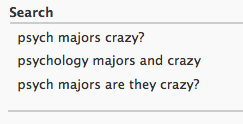
crazypsychThe above image shows some search terms people have used to find this blog.  This tells me two things.

1. People want to know if psychology majors are crazy.

2. There are people who don’t realize a “?” is unnecessary for a search engine.

This post will focus on the first observation, rather than the second. Though I do think the second is also important.

Please note: This post is purely conjecture. I have not met every single psychology major in the world or interviewed a sufficiently sized random sample. I can’t draw real conclusions about an entire group. Everything I am saying is just based on personal experience.

The title of my blog is intended to be a little tongue in cheek. I’m a psychology major and I might half-jokingly refer to myself as “crazy” so it seemed like a good blog title. Humor is a useful defense.

So are psychology majors crazier than the average person?

I think everyone is a little crazy, just in different ways and in varying amounts.

It takes a certain amount of sanity to be able to be in college. I think a better question is “Are psychology majors crazier than the average college student?”

I can’t really answer that. I don’t think anyone can.

I believe that I am probably crazier than the average psychology major as well as the average college student.

I know a lot of “crazy” psychology majors. But I just in general associate myself with fellow crazy people. Some of them just happen to be psychology majors. The majority are not.

Looking at my peers in class they don’t seem particularly crazy. They could perhaps be excellent at hiding it. People have many different motivations for an interest in psychology. Personal experience is just one of them.

A psychology major who happens to also be “crazy” likely has greater insight into their problems. I believe that insight helps a person function better and thus makes them less crazy. It blows me away how little some non-psychology majors know about the problems they are suffering from. Knowledge is very beneficial.

A non-psychology major who I know was recently diagnosed with social anxiety. When I first met her, I assumed she already had been diagnosed with it, because it seemed obvious to me. Last semester she was struggling with her classes. A large part of the problem was her fear of talking in class for oral presentations (she’d skip class when she had one or put off doing the assignment) and she skipped appointments she made to talk to the professor for help because she’d get too anxious. Eventually she went to the school counseling center where she was diagnosed with social anxiety. She hadn’t had a clue there were treatment options for her problem and is now getting help.

A psychology major might not have needed to wait so long to realize there were options available for help.

Hypothetically, if psychology majors are psychologically different from other majors this would pose a problem for some research being conducted at universities. Many psychology classes at colleges offer small amounts of extra credit for participating in one of the school’s research studies. While many psychological studies do have specific inclusion and exclusion criteria, often (at least at my school and others I have heard of) the ones available for extra credit are open to all. If psychology  students are “crazier” this could potentially be hurting the results of the study and making them less able to be generalized to the whole population.

In conclusion, I don’t have evidence to say whether or not psychology majors are crazier than the average college student. I just think those that are, are more aware of their personal crazy. This might cause them to be more vocal about it and maybe seem more crazy, but in the end the additional insight they have is able to help them.

What do you think?